


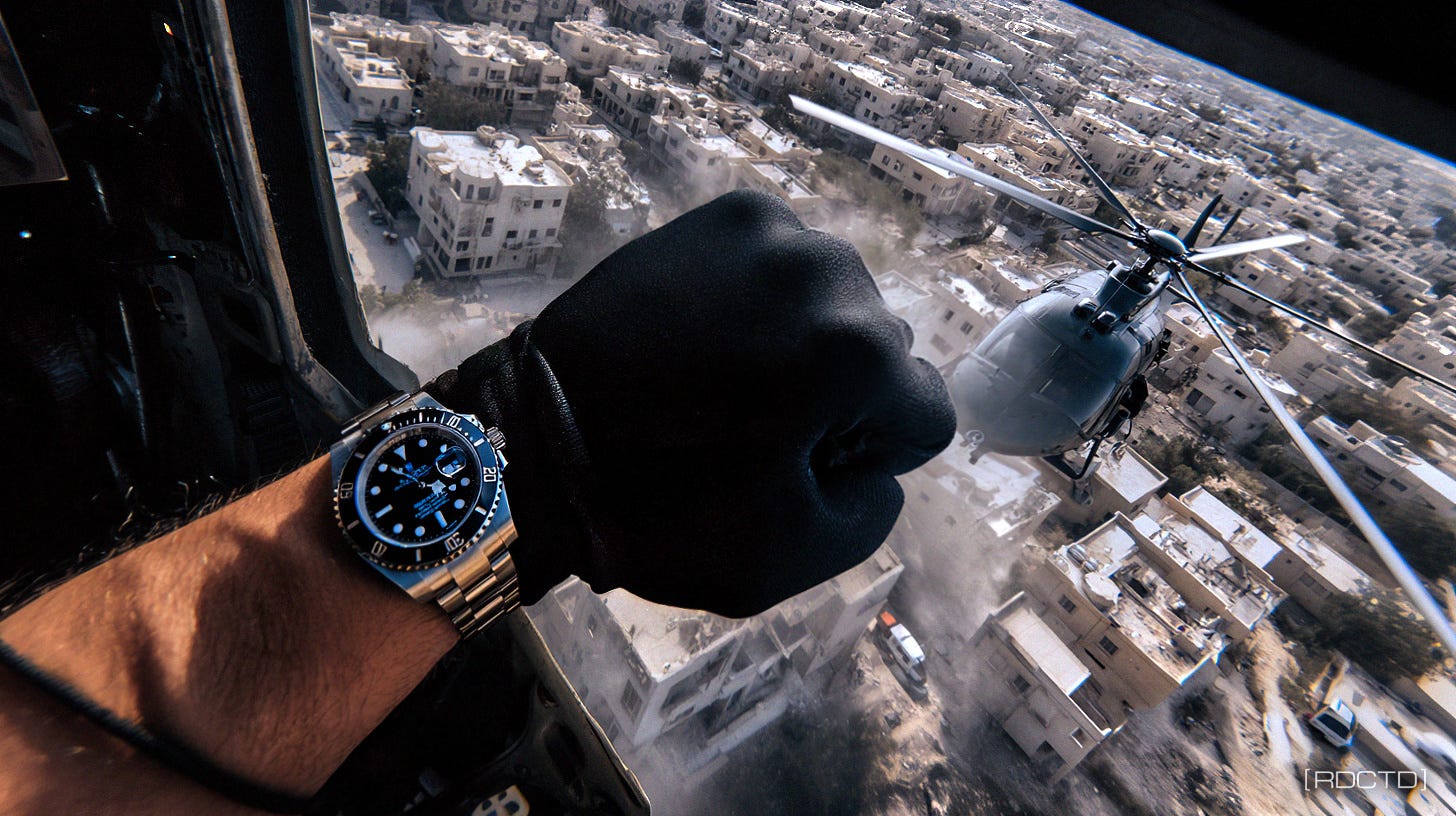
The same action can produce success or failure depending on the exact moment it’s taken, this is why timing is everything.
A better hand means little when played at the wrong moment, victory comes from playing yours at the right second.
That’s the part most people miss. They train, prepare, sharpen the skill, then spend it at the wrong moment and wonder why it failed.
An operative learns the opposite lesson early. One move, run by one person with one set of tools, can win at noon and fail at one o’clock. Nothing about the move changed. The conditions around it did, timing.
This is one of the few variables a civilian can actually control. You rarely get to choose the terrain, the people across from you, or the friction in your day. You can almost always choose the window. That’s where the advantage is, it costs you nothing but attention and patience.
Let me walk you through how operatives think about it, and how you can apply the same thinking to a salary negotiation, a hard conversation, a purchase, or a walk down an unfamiliar street.
Strategy becomes visible through action, but timing determines whether it works.
Timing = Strategy = Sequence = Timing
Every strategy is a sequence of actions arranged so each one creates the conditions required for the next. A move can be technically correct and still damage the plan when it occurs before preparation is complete, after the opportunity has passed, or outside the proper order.
Sequence is timing extended across multiple steps: observe, position, prepare, act, exploit, and disengage.
Strategy succeeds when each action lands at the moment of maximum leverage while preserving the next available move. Break the sequence and good actions begin working against one another - control the timing and the entire plan gains coherence, momentum, and effect.
Timing is the hidden architecture beneath every effective move.
Every System Runs on Rhythms
Nothing around you is steady. It only looks that way from a distance.
People run on cycles. Energy dips in the early afternoon. Patience thins by the end of a long meeting. Attention resets after an interruption.
Organizations run on cycles too - payroll dates, quarterly numbers, the lull right before a deadline and the panic right after.
Traffic has peaks and gaps. Stores have dead hours. Even a busy person checks their phone in predictable bursts.
An operative maps these rhythms the way a sailor reads tides. The work is called pattern-of-life analysis, the backbone of good tradecraft. You watch long enough to know when a place is alert or if it’s coasting. The moment can’t be forced, the advantage lies in waiting for one already leaning in the right direction.
You do a version of this without naming it. You know not to ask your partner for a favor the second they walk in tired. You know the DMV at 8 a.m. is a different animal than the DMV at 4 p.m.
Start treating those instincts as data. Write them down. The patterns get sharper once you stop trusting them to memory.
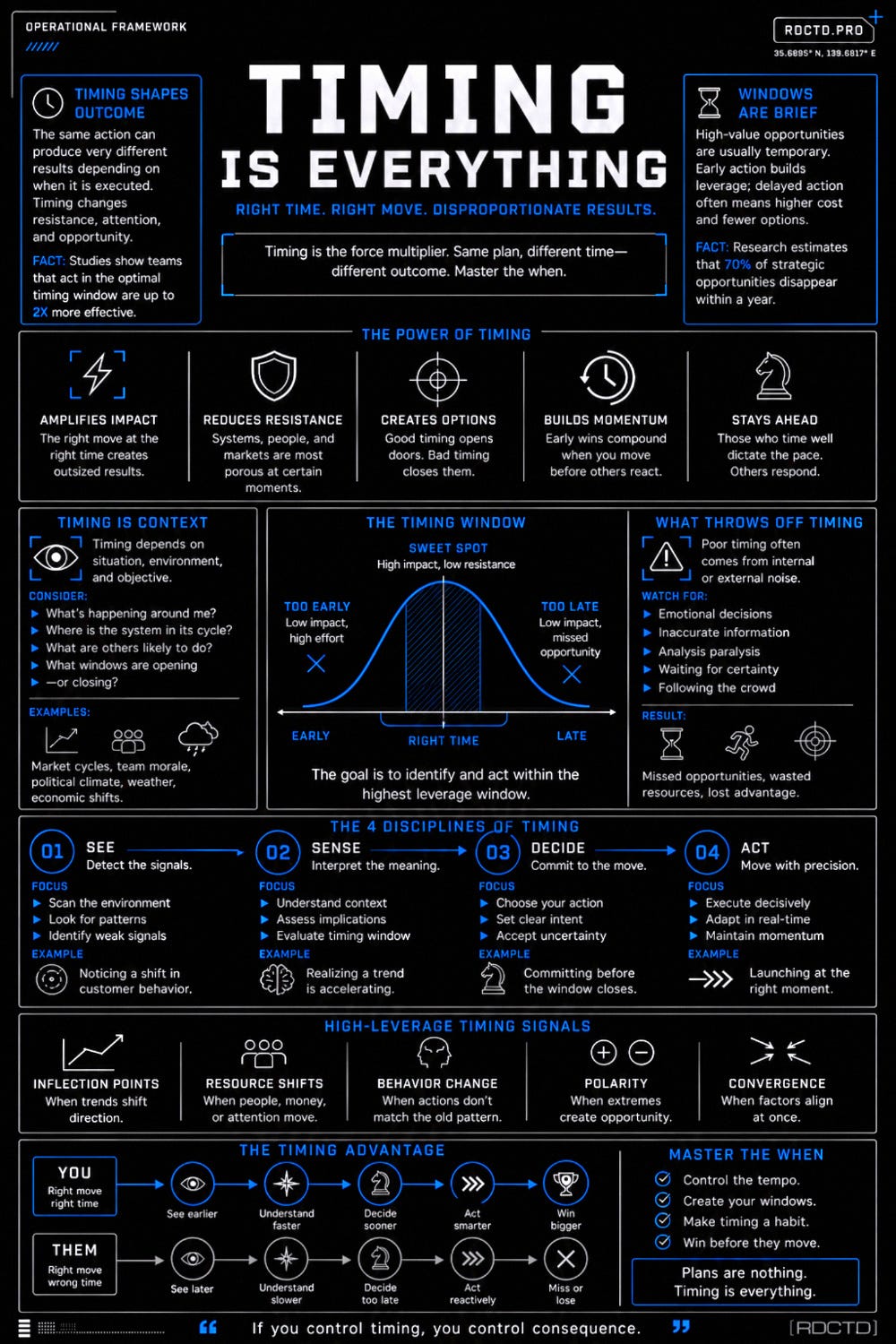
A moment becomes decisive when action and conditions align.
Find The Gap Between Noticing and Reacting
This is a detail from the field that pays off everywhere.
There’s always a delay between the moment a person registers something and the moment they organize a response. Awareness shows up first, coordinated reaction shows up a moment later. That gap is small, sometimes a second or two, but it’s real, and inside it resistance hasn’t formed yet.
A group is most exposed when it’s switching tasks, changing shifts, or turning its attention from one thing to another. The framework is still there, the cohesion isn’t. People are reorienting, sensors are noisy, nobody’s fully synced.
You can use the same seam in ordinary settings. Raise a sensitive point while a room is still forming its opinion, before anyone has planted a flag they’ll feel obligated to defend. Ask the busy clerk right as they finish the previous customer, not while they’re mid-task and half-listening. Merge when the lane is between clusters of cars, not when you’re forcing your way into a wall of them.
You’re arriving before the resistance organizes.
A plan without timing is only a list of intentions.
Initiative Over Strength
Strength is something you have. Initiative is something you create, with timing.
Whoever moves first inside a workable window sets the pace, framing, and order things happen in. That forces everyone else into reaction, which is always a smaller space to operate in.
Move early and you shape the field: you pick the angles, set the terms, and decide what gets handled first and what waits. Those small early gains stack up before anyone else has fully caught on.
Move late and you inherit the opposite. Doors are already closed. Decisions have momentum. Resources are committed along lines you didn’t pick. Now you’re negotiating with a situation from a weaker stance instead of steering it.
Think about buying a house in a hot market. The same offer, money, terms, is decisive on day one and worthless on day four after three other people have bid. Or a workplace decision - raise your idea before the memo is written and you’re shaping it - raise it after the decision is signed and you’re asking people to undo their own work.
Same idea, person, completely different result. The threshold moved while you waited.
Opportunity favors readiness, but readiness without timing still wastes the opening.
The Target Isn’t Fast or Slow…
People hear “timing” and think “speed.” Speed matters, but it isn’t the point.
Move too soon and you tip your hand. You expose your intent, trigger resistance before you’re ready, or burn energy holding a position you can’t sustain. Move too late and you’re working inside someone else’s finished setup, where your options have already narrowed to nothing.
What you’re after is neither rushing nor stalling, it’s entering at the moment your side is ready and the other side is in transition or open to it.
Operatives call it being “just in time”: you match what you can do to the moment the door is open, rather than acting on your own clock. That window is often brief and easy to miss. It opens when attention wanes, when fatigue peaks, when a decision is pending but not final, when an opinion is forming but not fixed.
Hitting it takes three things people underrate: observation, patience, and the nerve to wait through an incomplete setup without flinching.
Arrive before the window and you waste your leverage.
Arrive after and you’ve forfeited it.
Recognize the small opening and commit without hesitation, and average ability will outperform superior talent operating at the wrong moment.
Waiting is valuable only when it improves the next move.
Timing Multiplies Everything Else
Timing is a skill on its own, you can train it. It’s pattern recognition, restraint, situational awareness, and the judgment to tell real opportunity from noise.
But it also sits above your other skills, because it decides whether they ever get used well.
Your competence, preparation, intelligence, effort, all of it only counts to the degree you can deploy it under workable conditions. Act at the wrong moment and high competence gets throttled by resistance, distraction, and a reaction clock you can’t beat. Act at the right moment and the environment carries you instead of fighting you.
So timing doesn’t replace skill, it sets the return on skill.
Two people with identical ability will get wildly different results based on this one factor alone. Mastery isn’t only knowing what you can do but knowing when the system will let you do it with full effect.
Preparation builds capability, timing decides whether capability reaches the target.
Reading it on The Street
Let me ground this in something physical, because the principle is easiest to feel when your safety’s involved.
Say you’re walking and you decide to cross to the other side of the street. Cross too late, after a group has already locked onto you, and the move confirms you adjusted because of them. Cross too early and it reads as flight, an instinctive retreat that signals fear and marks you as reactive. Either way you’ve handed over information.
Now cross at a natural break instead: a light change, a gap in traffic, a shift in the flow of people. The exact same movement now reads as ordinary. You’re a person crossing a street, not a target peeling away. The timing keeps you neutral, which keeps you from being sorted into the category of prey. Nothing about your route changed. Only the moment did.
The same logic runs through every hard conversation.
Say the right thing too early, before the other person has shown their position, and you spend your leverage for nothing. Say it too late, after their pride has publicly committed them to a stance, and your words hit ego instead of reason. Say it while uncertainty is still in the room, before positions harden, and the same words land as helpful rather than hostile. The timing protects your influence.
Timing is the ability to recognize when resistance is weakest and commitment carries the greatest effect.
Why it Matters so Much: Momentum
Here’s the underlying reason all of this works. Outcomes are path-dependent.
Once a system commits, emotionally, financially, or procedurally, reversing it gets more expensive by the hour. A decision builds momentum. Momentum hardens into inertia. The longer a direction gets reinforced, the more weight it carries, both in people’s heads and in the institutions around them. That’s why the cheap moment to act is almost always early, while things are still fluid, and the costly moment is late, after everything’s set.
Operatives obsess over this because in the field the difference between friction and flow is often measured in seconds. Most failures aren’t failures of ability, but of synchronization - the right action taken at the wrong time.
Timing is the operational use of patience.
How Operators Master Timing
Timing is a trainable skill:
