


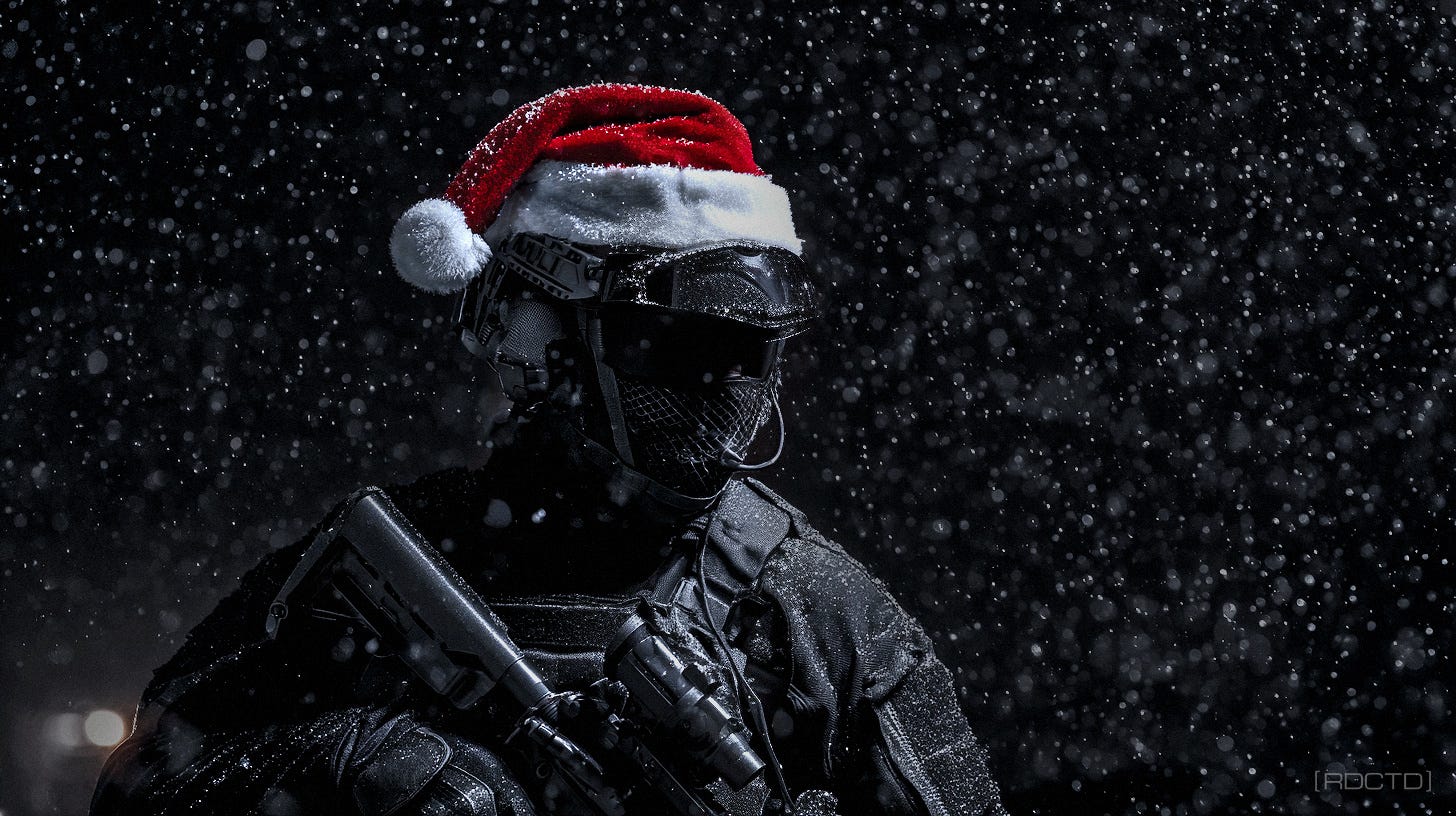
As with most mythics, Santa Claus has feats that require a special set of skills. Using him as an archetype, this intel makes his abilities real and practical.
Skill is economy of motion applied to decision-making.
This intel was originally published on RDCTD.
Universal Access Mindset
Santa enters anywhere without force. Chimneys are symbolic. The real skill is mindset. Operatives must see access points others ignore. This includes social access, administrative access, maintenance cycles, and human habits. You train yourself to think laterally. Locked doors are rarely the problem. People, routines, and assumptions are. You enter by fitting in, not breaking in.
Shape the environment so access is granted by default. Build the pretext, align with routine, and arrive inside a window where your presence is expected. The cleanest entry doesn’t look like entry at all – it looks like normal traffic.
Pattern-of-Life Mastery
Santa doesn’t guess when someone’s asleep. He knows. That comes from long-term observation and pattern recognition. For a covert operative, this means building a detailed pattern-of-life on a target or environment. You log routines, deviations, emotional states, and seasonal changes. You do this quietly, over time, and from multiple angles. You don’t rely on a single source. When you move, you do so inside predictable gaps. That’s how you avoid friction and exposure.
Patterns don’t pay off unless you track what breaks them. The moment something deviates - timing, posture, route, mood, rhythm - that’s the signal that matters. Treat anomalies like a compass.
Load Management & Mobility
Santa carries an impossible payload and still moves fast and efficiently. That’s load discipline. Operatives fail when they over-carry. Every item must earn its weight. This includes gear, cover stories, digital footprint, and emotional tells. You streamline until movement feels natural. Mobility isn’t speed. It’s the ability to adapt without stopping.
Gear that never gets used isn’t insurance, it’s friction you carry into every movement. Each unnecessary item taxes your speed, your attention, and your ability to adapt under pressure. Everything on you needs a clear purpose.
Behavioral Camouflage
Santa is never suspicious. That’s deliberate. Behavioral camouflage is about matching emotional tone, tempo, and expectations of the environment. Operatives don’t hide by being invisible. They hide by being correct. Your posture, pacing, and micro-expressions should align with the setting. You’re forgettable because you’re appropriate.
People don’t catalogue what they see; they catalogue what interrupts their sense of normal. When your tone, tempo, and posture don’t match the room, their attention locks in and their memory sharpens.
Distributed Presence
Santa appears everywhere without being seen traveling. For operatives, this is distributed presence. You pre-position assets, relationships, and information so you don’t have to move when it matters. Presence is established before the operation begins. You seem omnipresent because your groundwork is deep and quiet.
Movement is the part everyone can see, so it’s the part that gets remembered, logged, and explained after the fact. Pre-position what matters, you shape timing, and you remove surprises until execution feels routine.
Temporal Exploitation
Santa operates on timing, not speed. He moves when resistance is lowest and attention is elsewhere. For an operative, this is about exploiting temporal windows. You identify when systems, people, or environments are most permissive. Late hours, shift changes, holidays, routine fatigue cycles. You don’t rush actions. You wait for the clock to work for you. Timing reduces risk more than skill ever will.
Don’t waste bandwidth asking whether something is possible – that’s the wrong question and it keeps you reactive. In tradecraft, timing isn’t a convenience, it’s the multiplier that turns a risky move into ordinary traffic.
Expectation Engineering
Santa succeeds because people expect him to behave a certain way. Operatives do the same by shaping expectations long before execution. You seed ideas, habits, and assumptions so your presence or actions feel normal. When something aligns with expectation, it goes unexamined. You build perception, not fight it.
People rarely interrogate what fits the story they’re already telling themselves. Your job is to shape that story early, with consistent cues and a routine that feels self-explanatory.
Silent Logistics
Santa’s operation is logistics-heavy and visibility-light. That’s the lesson. Operatives must move resources, information, and influence without drawing attention to the supply chain. You decentralize storage. You avoid single points of failure. You plan redundancy quietly. The operation never pauses because one piece fails.
Build depth: alternate paths, alternate methods, and a fallback that still completes the objective if something fails. Strategic redundancy is what keeps pressure from snapping your operation in half.
Identity Containment
Santa is instantly recognizable, yet personally unknowable. That’s identity containment. Operatives must control how much of themselves exists in the environment. You present a stable surface identity and protect everything beneath it. You don’t over-explain. You don’t improvise personality. Consistency is what keeps scrutiny low.
The more you disclose, the more you’re obligated to keep consistent under scrutiny. Every added detail becomes a memory tax, and memory taxes compound when stress hits.
Moral Cover Utilization
Santa operates under moral cover. He’s perceived as benevolent, harmless, and non-threatening. Operatives exploit moral cover by aligning with causes, roles, or narratives that disarm suspicion. Teachers, volunteers, helpers, professionals. You’re shielded by context, hidden in plain sight.
Assume positive intent, and their threat filter relaxes on its own. Moral cover isn’t softness in tradecraft – it’s a precision tool that buys you time, lowers scrutiny, and opens doors without resistance.
Environmental Legibility
Santa never misreads the environment he enters. He understands space instantly. For an operative, environmental legibility is the ability to read a room, a street, or a structure at a glance. You assess movement flow, sightlines, sound behavior, social hierarchy, and exits without stopping. You notice what belongs and what doesn’t. This allows you to position yourself correctly and adjust before attention ever lands on you.
The space is giving you instructions, whether you listen or not. Read the cues – pace, noise, sightlines, and social rules – then move in a way that matches what the environment already expects.
Operational Restraint
Santa only takes what’s necessary and leaves no trace. That’s restraint. Operatives fail more often from excess than from lack. Operational restraint means limiting actions, words, and objectives to what directly supports mission intent. You don’t add steps. You don’t embellish success. You exit clean. The best operation is the one no one revisits.
Every extra action is a new data point for someone else to notice, record, and connect later. Keep your moves tight: only what advances the objective, only what you can justify without talking, only what you can repeat.
When skill replaces thought, bandwidth opens up.
These skills are charmingly whimsical on Christmas day but strategically foundational every other day. Santa Claus is effective because his methods are disciplined, patient, and effective. That’s the same standard expected of covert operatives operating at a professional level in the real world.
Source: RDCTD
Original article: https://rdctd.pro/santa-claus-skillset/


This is brilliant
When necessary, Santa sleighs.