


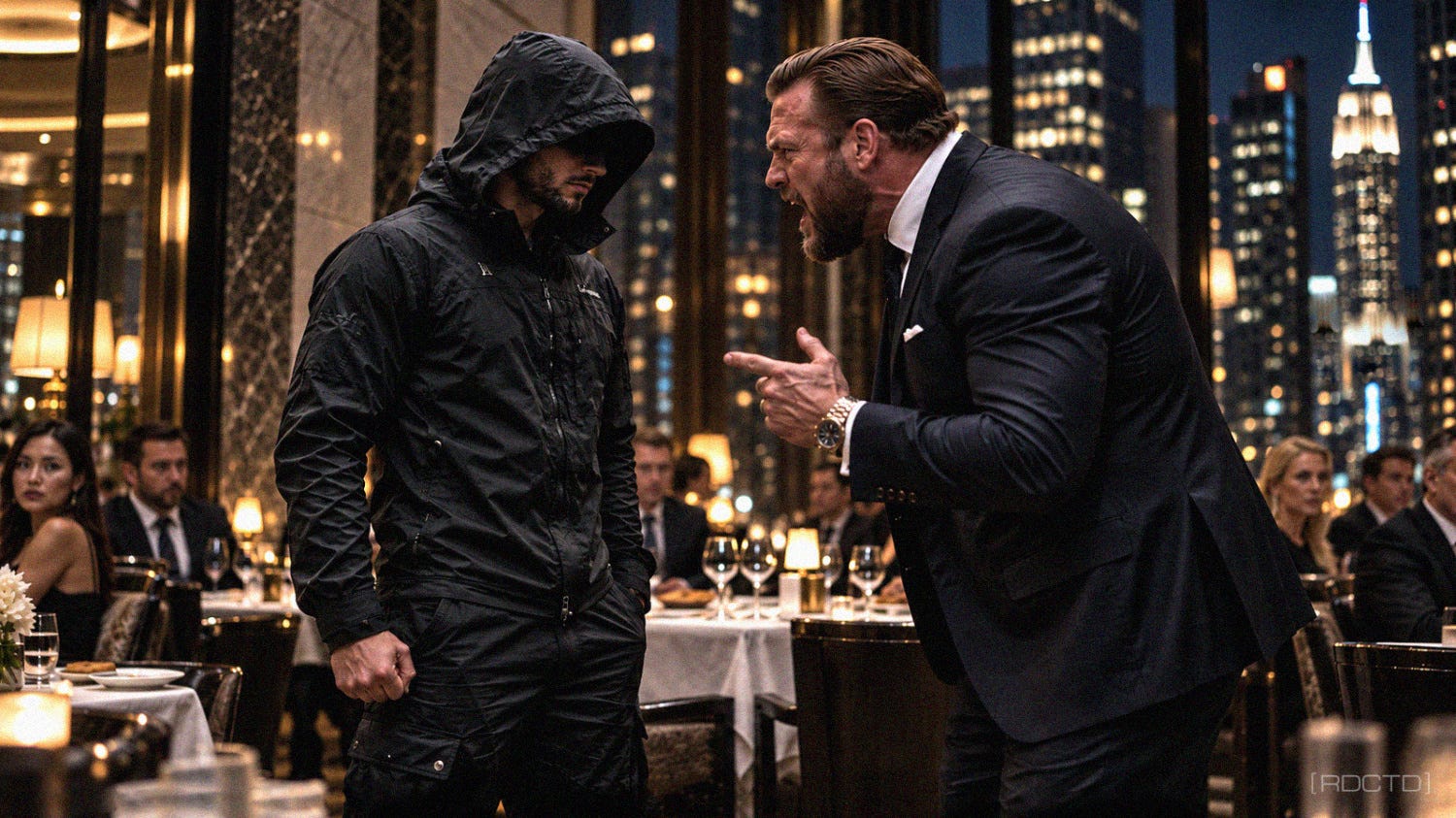
This is a pre-emptive defensive striking maneuver deployed in the middle of a hostile’s threat.
The ‘Mid-Sentence Strike’ is a straightforward and logical name simple enough for anyone who’s ever stood in a bar, a parking lot, or a doorway while somebody puffed up their chest and started talking shit.
To threaten is the enemy of action. When they talk, they tell you where to strike. When they threaten, they tell you when. Listen closely, then hit before they finish.
Most people believe a fight should technically start after the “talking” ends. You say your piece, I say mine, then we go. The covert operative’s version throws that out, you hit during the talking - not after it.
Why? Because the human brain is bad at doing two things at once. Speaking and staying fight-ready use the same limited processing power. When someone is busy forming words, choosing insults, and managing their tone, they’re quietly starving their own reflexes. That’s the window.
You don’t have to be a trained killer to use this, just notice the moment and act on it.
Speech is an exploitable liability. The moment a person opens their mouth to threaten you, they open their guard. The period at the end of their sentence is the dot on your target.
Talking Makes You Vulnerable
Speech can be cognitively draining, especially when emotionally charged with words of violence. It costs the brain bandwidth that would otherwise be spent tracking / predicting kinetic threats and preparing the body to move.
The Mechanism — Producing speech lights up the language centers of the brain, pulling resources away from the motor areas that get you ready to fight or flee.
The Timing Problem — Striking mid-word catches a person with a half-finished breath and their weight not yet set. They can’t brace because they hadn’t decided to brace yet.
Sensory Overload — The brain monitors its own voice while talking. That attention is stolen from watching the world around them, namely, you.
The Emotion Tax — Threatening speech is highly emotional speech. The angrier the delivery, the sloppier the thinking.
A talking opponent is a distracted opponent, a silent one is not - that distinction is key. The moment their mouth starts moving, their mind leaves the fight and goes to the argument. So the question you ask yourself is never “are they ready?” - it’s “are they talking?” If the answer is yes, they’re not ready… but you are.
The conversation ends when you decide it ends, not when they finish. Your reply is kinetic punctuation.
The Expectation Gap
Civilian life runs on politeness. We’re taught to wait our turn, let the other person finish, then respond. Most of the time there’s nothing wrong with that, but not when your safety or life is on the line.
Your opponent expects you to wait. That expectation is a comfort blanket. Attacking mid-sentence rips it away at the exact moment they feel most in control.
The principle. Social scripts demand turn-taking. We wait, they wait, and the exchange unfolds in an orderly back-and-forth. Break that script and you trigger a freeze - a mental stutter that hits before the body ever gets the chance to react.
The application. Hit at the peak of their threat if position allows. That’s the exact moment their confidence is highest and their guard is lowest. Waiting until they finish hands the timing back to them.
The double delay. Now their brain has to process two things at once: the annoyance of being interrupted and the shock of (ironically surprising) violence. Those two signals contend each other, and the conflict slows the response even further.
Seizing momentum. Once the social contract is broken, you dictate the terms. They’re forced to abandon their script and improvise, you’re already working from a plan.
Courtesy in a fight is a civilian habit, for the operative, it’s a trap to be avoided. The person who thinks you’ll let them finish has already lost the fight, they just don’t know it.
The sentence they never finish is the fight they never win.
Reading Escalation
Not every sentence deserves an interruption. Timing is targeting, you strike when the words signal that the body is about to move. Talk too early and you waste the surprise on an opponent who wasn’t committed yet, talk too late and you’ve handed them back the initiative. The skill is in the gap, in reading the exact breath where their sentence ends and their muscles begin to load.
Watch for:
Weight shifting onto the balls of the feet.
The voice dropping in pitch, which usually precedes the swing.
Sudden stillness after fidgeting, or a restless shuffle that replaces words with movement.
A deep breath that expands the chest - fuel for a lunge or a shout.
The chin tucking down behind the shoulder - a sign they’re protecting the jaw and committing.
Shoulders squaring up to line you up, or one shoulder turning to load a rear hand.
The lead hand drifting up or the fists forming.
Blading the stance - one foot sliding back as they angle their body away from you.
Listen for the trigger phrases:
“I’m gonna…”
“What are you gonna do about it?”
“You better…”
“You want some?”
“Last chance…”
“So what?”
The instant a threat becomes explicit is the instant to strike. They think the timeline is theirs, prove otherwise.
Deception creates the opening, violence closes it. By the time they spot the first, the second is already moving.
How to Actually Do It
The strike must match the moment. Because the target is mentally off-guard but physically loose, deploy one decisive shot or three hit combo. The element of surprise gives you a single clean opening, so every shot must be aimed at something that ends the exchange without prolonging it.
Conceal your intent:
None of this works if they see it coming. Your body has to sell the idea that you’re still just chatting while your feet quietly get you into striking range.
Open hands, calm face. Loose shoulders and a slack jaw read as “safe” to their threat radar.
Lean in like a good listener. Use nods and little affirmations to disguise each creeping step forward.
Match their breathing. Copying their rhythm builds subconscious rapport and delays their reaction. Strike as their chest rises on the inhale - the arms naturally open and the target is exposed.
Close the distance while they talk:
Drift in behind a conversational posture. Keep soft eye contact and relaxed shoulders. Slip the last half-step into range on the final word. If they notice you moving at all, they should read it as interest in what they're saying - never as the first move of a fight.
Time it to the open mouth:
Certain sounds — P, B, T, K — force the jaw wide. A strike to the jaw hinge at that exact instant lands on a joint that is mechanically wide open, with no muscle tension to absorb it. The result is a jolt to the base of the skull: no words, balance, and coordination.
