



Covert operatives use this to sort information into what they know, what they know they’re missing, what they’ve overlooked, and what they haven’t considered - to make better decisions.
It’s a way to guide observation and orientation by exposing information gaps and judgments that rely on inference.
A confident decision can still fall apart over a question you never thought to ask. You can think a decision through carefully and still miss something that changes everything.
Sometimes you may be missing an answer. Sometimes you’ve already got the answer but it’s buried in an email, a past experience, or someone else’s head. Sometimes you could be relying on information that was accurate last month. And sometimes a problem appears that you never even considered.
Tradecraft requires working with those limits. An operative has to make decisions while keeping track of how much remains uncertain. That habit has everyday value when you’re managing a project, planning travel, learning a skill, or committing your time to something demanding.
The known unknowns matrix organizes information into four categories. The names sound awkward and redundant at first, but each describes a familiar situation.
Known Knowns are what you can explain, Known Unknowns are what you can question, Unknown Knowns are what you have yet to recognize in your own experience, and Unknown Unknowns are what your questions still can’t reach.
Known Unknowns: The Answers You’re Missing
A known unknown is something you’ve identified as missing information.
You’re preparing a presentation, but you haven’t confirmed how much time you’ll get. You’re organizing a group trip, but two people haven’t committed. You’ve agreed to complete a project, but nobody’s clarified who can approve the finished work.
You understand the gap well enough to investigate it.
The practical move is to make that gap specific. “I need to know more about this project” leaves you with an open-ended research assignment. “I need the final delivery date and the name of the person approving it” gives you something you can resolve.
Some unanswered questions deserve more attention than others, you have to figure out which is which. The missing detail that could force you to redo a week’s work deserves attention before a minor preference you can accommodate later.
Give important gaps a deadline, an answer has value while you can still use it. Learning that your presentation slot has been cut in half helps considerably more before you’ve finished building forty slides.
You’ll sometimes have to act while a question remains unanswered. State the assumption you’re using and keep the commitment proportionate. If you haven’t confirmed the audience size, you can prepare material that works for a small group and can be adapted without rebuilding the whole session.
Turn uncertainty into a specific task.
Leave enough room in your plan for a fact you haven’t encountered yet.
Unknown Knowns: The Information You Haven’t Used
An unknown known is information you already possess, or could access within your group, whose relevance hasn’t registered.
This category is easy to overlook because the information doesn’t feel missing.
You keep promising yourself that you’ll finish demanding work after dinner. Your recent experience shows that you rarely have the concentration for it. You know this pattern, yet every new schedule assumes the evening will go differently.
Or your team spends an afternoon investigating a recurring problem that a colleague solved last year. The answer exists, it just never reached the people doing the work.
Unknown knowns include forgotten lessons, practical experience you haven’t put into words, and details that were passed along without enough context.
Recovering them takes a different kind of attention. Review what happened the last few times you faced a similar situation. Read the notes you made when the outcome was still fresh. Bring in the person who regularly handles the work, including whoever deals with the mistakes afterward.
Experience can also appear as an uneasy feeling before you can explain it. You might hesitate over a deadline because you’ve seen similar assignments expand halfway through.
View that reaction as a reason to examine the details. Identify the specific cues: unclear requirements, delayed feedback, or repeated requests described as minor additions. Your reactions are actionable when you can explain what produced it.
Intuition can alert you to something worth checking. Familiarity, anxiety, and personal bias can produce strong reactions as well.
A backup plan deserves scrutiny wherever it shares a dependency with the original.
Known Knowns: The Information You Can Support
Known knowns are the things you’ve checked well enough to use in the decision you’re making.
You’ve received the final brief, tested the equipment you’ll actually use, confirmed the appointment directly, completed a comparable task and recorded how long it took.
These facts give you a basis for action. Their usefulness depends on being precise about what they establish.
Finishing one assignment in three hours tells you something about that assignment under those conditions. A new assignment may involve more difficult material, additional review, or interruptions you didn’t face before.
The phrase “I know” often covers several different things: direct experience, someone else’s assurance, an expectation, or a preference you’ve repeated until it feels settled.
Separate them.
“The organizer confirmed a thirty-minute slot this morning” gives you a clear basis for planning. “These events usually give speakers thirty minutes” still leaves something to verify.
Repetition can also create false confidence. Several people repeating the same unconfirmed message haven’t independently checked it.
For information that’s critical, keep track of where it came from and when it was checked. Revisit it when relevant conditions change. A reliable fact can become outdated while you’re still building plans around it.
Agreement tells you how many people accept an explanation, the evidence still needs checking.
Unknown Unknowns: The Problems You Haven’t Recognized
Unknown unknowns are relevant possibilities that haven’t entered your thinking.
You’ve planned around the problems you can imagine. Something outside that understanding can still affect the result.
An unfamiliar process may contain an extra approval step. Two seemingly unrelated tasks may depend on the same person. A change elsewhere in an organization may alter what your assignment requires.
Once you recognize one of these possibilities, it becomes something you can investigate. You’ve turned an unidentified problem into a known unknown.
You can expose some blind spots by getting another perspective. Someone with different experience may notice a dependency you’ve overlooked or question a condition you’ve treated as automatic.
Describe the situation before explaining your preferred solution. That gives the other person more room to examine the problem independently.
You can also imagine that the plan has failed and work backward through plausible causes. This exercise often brings ordinary weaknesses into view: insufficient preparation time, a misunderstood requirement, or too much responsibility resting with one person.
You’ll still miss things.
Allowing some spare time, keeping your first commitment manageable, and preserving room to revise the plan helps you respond when new information comes. Packing every hour and committing every available resource leaves little capacity to recover.
The purpose is to make uncertainty manageable without spending your life anticipating catastrophe.
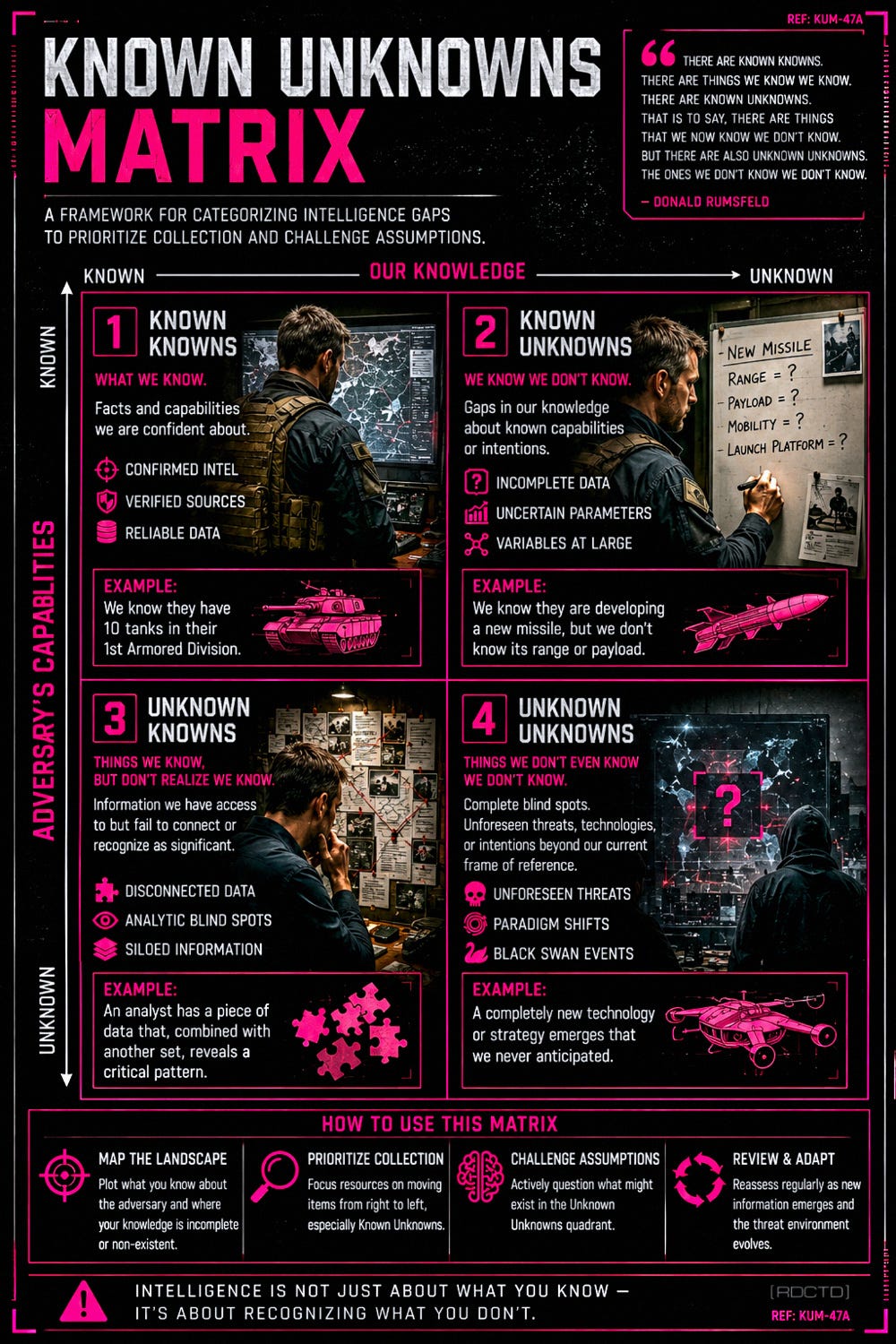
Put the Matrix Into an Ordinary Decision
Suppose you’re asked to run a workshop at work. You’ve delivered presentations before, and the subject is familiar. Agreeing immediately would be easy. A brief review reveals several separate issues.
Your known unknowns include the participants’ experience and what they’re expected to do after the workshop. Those answers affect the level of instruction and the exercises you prepare.
Your unknown knowns include a lesson from your last session: you spent too long explaining background material and rushed the practical work. A colleague also knows that several attendees have already completed introductory training.
Your known knowns include the confirmed date, the room booking, and the material you’ve already developed. You can build around those facts while checking anything that may have changed.
Your unknown unknowns remain outside the current assessment. An experienced facilitator reviewing your outline might reveal that the workshop is expected to support an upcoming procedure you haven’t been told about. That discovery creates a new question to resolve.
The review changes your preparation. You clarify the expected outcome, shorten the introduction, use what your colleague knows about the audience, and leave enough time to adjust the exercises.
You’ve improved the workshop before creating more material.
That’s how the matrix can be useful - it helps you direct effort toward the parts of a decision that need attention.
Information can be accurate and still answer the wrong question.
Final
You’ll can’t rely on having every answer before you act. This matrix helps you recognize where your understanding ends and which gaps deserve attention. Use it to check your assumptions, recover overlooked lessons, and leave enough room to adjust when new information changes the decision.


