


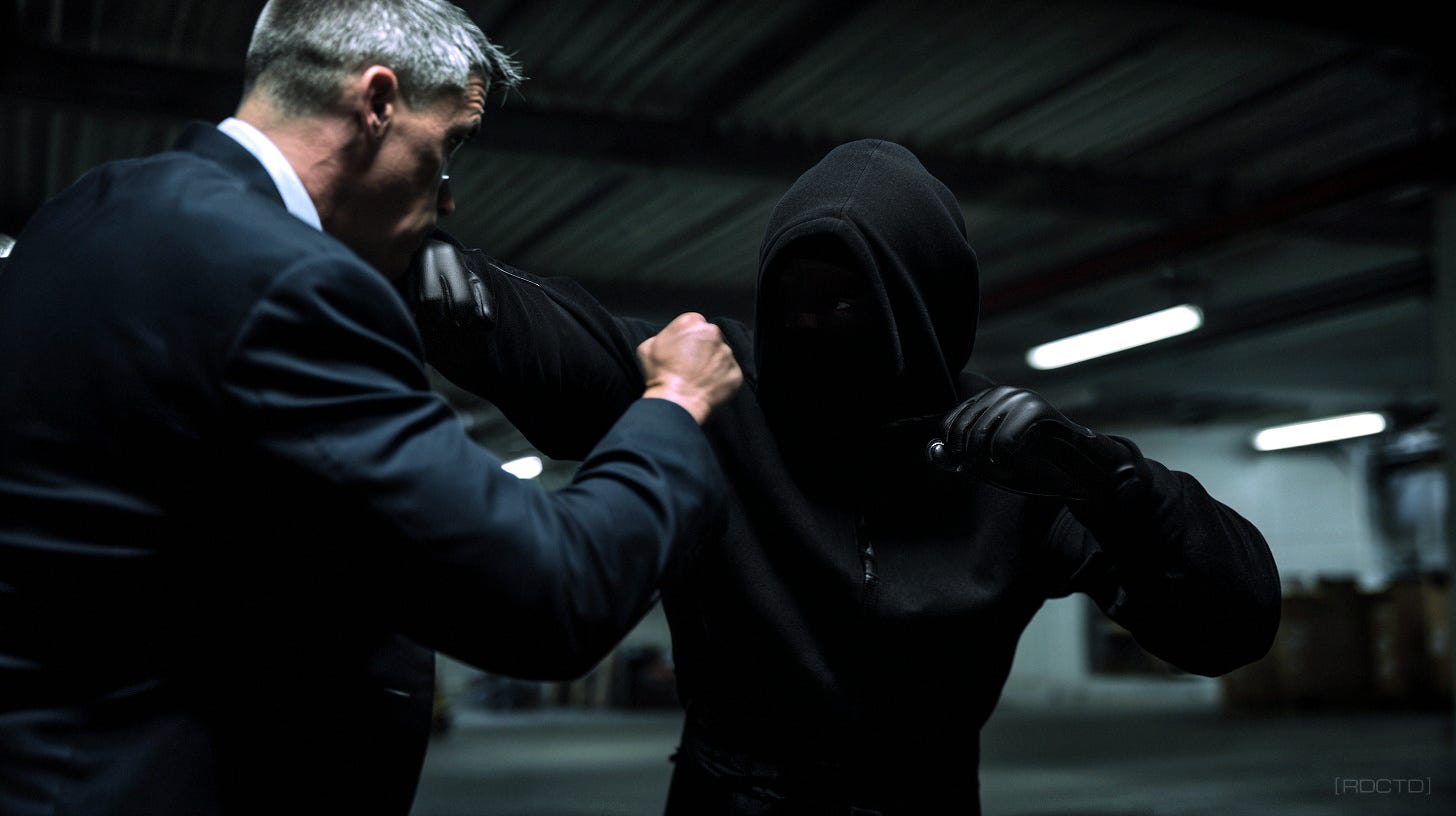
There’s no good way to get punched in the face, but there is a strategic way - so you stay on your feet to engage (or disengage) optimally.
Violence rewards initiative.
This is damage management, not a combatives technique. In kinetic encounters, you’re buying seconds of function - enough to keep your balance, protect your brain, and move to a better position. The main threat from face/head punches is rapid head acceleration and rotation, not “pain tolerance.”
Scan for hands that disappear. If someone’s hands drop out of view near pockets, waistband, or behind the body, treat that as a decision point and start creating distance.
The Operating Goal
A punch to the face is a stability event. If your head gets snapped or spun, your balance, vision, and timing degrade fast. So the objective is to keep your head from becoming a lever, keep your feet under you, and stay functional long enough to move, cover, and reset.
Your priorities, in order:
Reduce Head Whip (especially rotation): Rotation is the fast track to losing orientation, and that’s when follow-up shots stack damage. Pack the neck and keep your head “on rails,” not swinging off-axis.
Protect The Jaw Hinge and Bite Alignment: A loose jaw is a shutdown switch, and a misaligned bite can turn into a long-term problem you can’t ignore. Keep the teeth lightly set and the tongue up so the impact has fewer moving parts to exploit.
Stay Upright and Stable so You Don’t Take a Second Impact (especially the back of the head into a wall/curb/floor): The floor is undefeated, and secondary impacts are where incidents turn catastrophic. Your base is life insurance - rebuild it immediately and don’t let the hit decide your posture.
This is about keeping your structure connected so the hit doesn’t steal your balance and awareness. If you can limit the whip and stay upright, you’re still in the fight mentally - even if your face is telling a different story.
Read shoulders, not fists. Hands lie in motion, shoulders broadcast intent a fraction earlier if you’re trained to watch them.
Pre-Impact Setup (Your Default “Loaded Spring”)
Pressure strips you down to whatever you’ve rehearsed (trained). So you’re building a default response that shows up on contact: head stays stacked, jaw stays set, breath stays moving, and your feet keep you upright. That’s tradecraft in the body, simple mechanics you can run when your thinking gets loud.
