


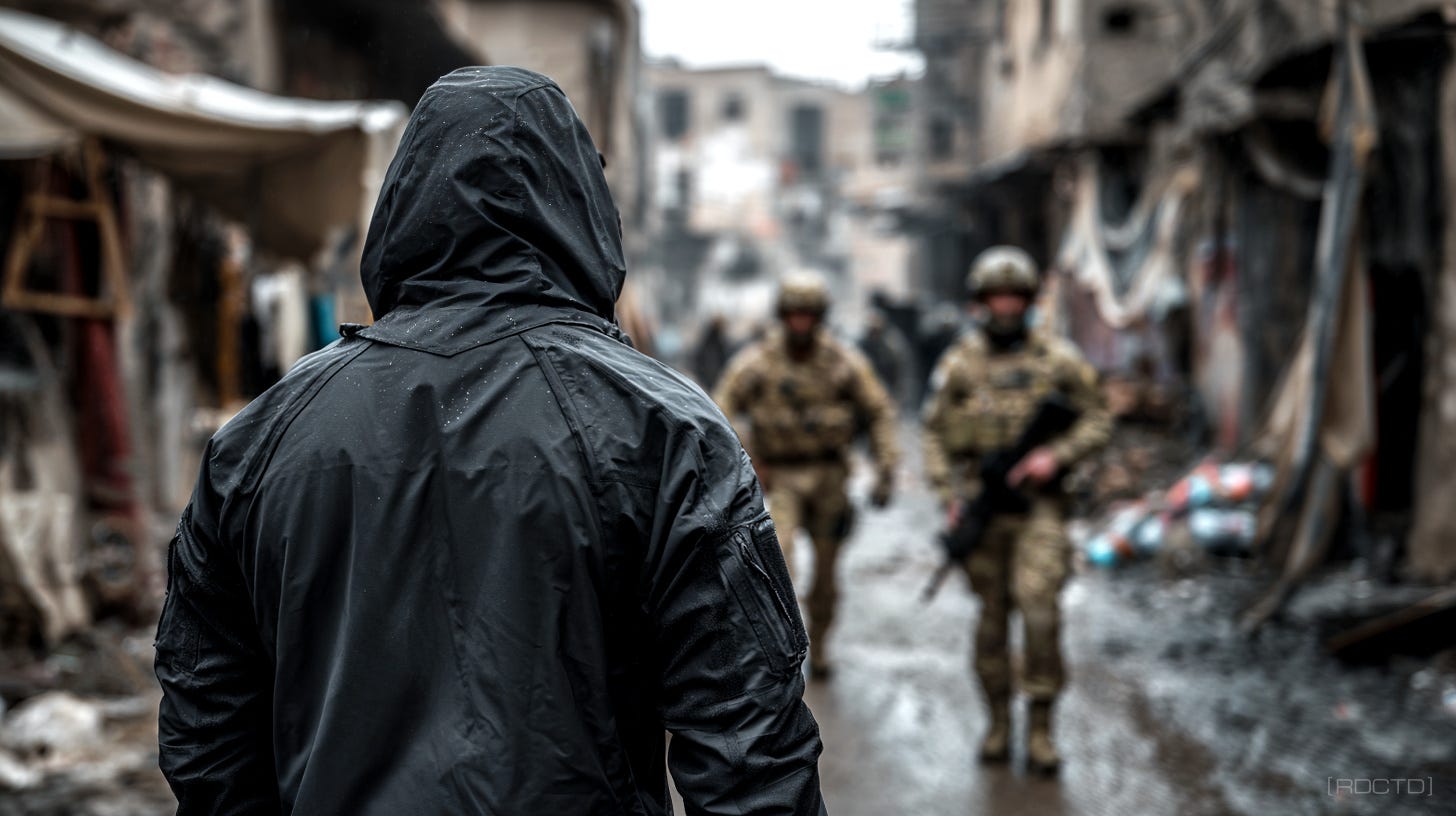
Before acting on fear, ego, or adrenaline - run this protocol so you’re responding to facts instead of feelings… stopping urgency, anger, or hype from deciding on your behalf.
A brief, codified interlock to take a breath (e.g., tactical pause) when in the field to force separation between what feels risky and what the evidence supports before you commit to an irreversible move. -RDCTD
In the field, covert operatives don’t get many second chances. A rushed read of a room can compromise an identity. A poorly timed reaction can spook a contact. A moment of ego or panic can turn a manageable situation into a hard problem. That’s why tradecraft relies on small, repeatable habits that keep emotion from quietly steering the decision.
One of those habits is the Affect Heuristic Check. Operatives use versions of it during surveillance detection, meetings, and any moment where urgency is being manufactured. It forces a clean separation between what your body is feeling and what the environment is actually telling you. That separation buys you clarity.
In civilian life, the stakes look different, but the pattern is the same. You still face irreversible moves. You still get pushed by speed, pressure, and social friction. This is a structured pause that helps you stop mistaking emotion for evidence.
Slow down at the exact moment everything inside you wants to speed up.
The Affect Heuristic Check
The AHC is a fast, deliberate checkpoint you run when your emotions spike and you’re about to act. It’s designed to catch a common mental shortcut: when your brain uses a feeling (fear, excitement, disgust, anger, urgency) as a substitute for analysis.
That shortcut is the affect heuristic.
It’s a normal human feature, and it’s useful when time is short. It’s also dangerous when the feeling is intense, because intensity makes you confident even when you don’t have facts. The Affect Heuristic Check exists to interrupt that pattern long enough for reality to re-enter the decision.
When you run it consistently, you become harder to manipulate. Most manipulation depends on emotional acceleration, the AHC forces deceleration.
When your mind narrows to one option, that’s your cue to widen the frame.
When to Run the AHC
You should run an Affect Heuristic Check any time you notice your internal “speed” change. That can look like feeling rushed, provoked, unusually confident, or strangely compelled. It can also show up physically, such as shallow breathing, tight shoulders, tunnel vision, shaky hands, or a feeling that you have to act right now.
Another tell is mental narrowing, when you stop considering alternatives and start fixating on a single action as “the only option.” You’ll also see it when you’re mentally rehearsing an argument, a comeback, or a justification, because that’s your ego trying to drive.
It’s especially important when the next step is expensive or difficult to reverse. Sending money, signing something, escalating a confrontation, getting into a vehicle with someone, posting publicly, or walking deeper into a situation that feels wrong all qualify.
Manufactured urgency is a major trigger here, especially phrases like “last chance,” “right now,” or “don’t tell anyone,” because they’re designed to prevent verification.
If the move is reversible, you can be looser. If it isn’t, you should earn the decision with an AHC.
The moment you feel cornered, widen the room.
How to Run the Affect Heuristic Check
This isn’t meant to be a long ritual. With practice, it can take near-instant time - one breath, one label, one quick scan of facts - before you move. In a higher-pressure moment, it might take a few extra seconds because the environment is noisy, your body is louder, or the stakes are higher.
Either way, the goal stays the same: create a small gap between impulse and action so you can choose deliberately instead of reacting automatically.
Step 1: Freeze the Next Move
The first rule is don’t take the next step while your body is “hot.” Don’t hit send. Don’t close distance. Don’t agree, pay, or escalate. If you can, break the momentum physically by changing posture or position. Sit down, pivot your shoulders away, or take one step sideways.
Momentum creates commitment, and commitment is where people make avoidable mistakes.
Step 2: Take One Counted Breath
Now create a small gap between impulse and action. Inhale slowly and count it, then exhale slowly and count it. Keep your attention on the count, because it anchors your mind to something real instead of the story your adrenaline is trying to write.
The point isn’t to “calm down” instantly. You’re forcing a pause long enough to regain choice. That gap is the point of the AHC.
Step 3: Name the Emotion, Plainly
Label what’s happening internally with a short, direct sentence. “I’m angry.” “I’m anxious.” “I’m excited.” “I feel rushed.” Don’t justify it and don’t dramatize it.
Naming it reduces its control and turns the feeling into information instead of instructions.
Step 4: Write the Facts, Not the Story
Next, switch to evidence. List what you know as observable facts only. “He raised his voice” is a fact. “He’s trying to intimidate me” is an interpretation. “This link came from an unknown number” is a fact. “This is definitely a scam” is an interpretation.
If you can’t produce concrete facts, assume you’re operating mostly on affect and treat your confidence as unreliable.
Step 5: Run the Four-Question Reality Test
Use these questions to pressure-test your read. Answer quickly, with honesty.
Base rate: How often does this type of situation go bad for people like me?
Alternate explanation: What’s the simplest, least dramatic explanation here?
Cost of being wrong: If I’m wrong, what’s the damage?
Reversibility: Can I undo this decision easily, or is it a one-way door?
Don’t look for perfect certainty. Just make enough friction to stop an emotional lunge.
Step 6: Choose the Lowest-Regret Action
End the AHC by selecting a move that keeps options open and limits exposure. In practice, that usually means one of four things: delay, verify, exit, or reduce commitment. You can say, “I’m going to think about it and get back to you.” You can verify details through an independent channel. You can move the meeting to a public place, bring someone, or simply leave.
If you can’t identify a low-regret move, that’s your signal to back up further and give yourself more distance before you act.
When someone demands immediacy, they’re usually afraid of your second look.
What the AHC Looks Like in Normal Life
If you’re about to send money because an opportunity feels too good to miss, the Affect Heuristic Check usually reveals urgency and excitement with very few hard facts. In that situation, the low-regret move is to slow down and verify. Confirm identity. Confirm details through a second channel. Use payment methods that provide protection. If the opportunity can’t survive basic verification, it wasn’t an opportunity. It was pressure.
If someone provokes you in public and you feel your ego flare, the AHC reminds you that you don’t know their intent, you don’t know who they’re with, and you don’t know what the next thirty seconds becomes if you escalate. The low-regret move is disengagement and distance. In real terms, that means creating space, ending the interaction, and leaving. “Winning” a moment is rarely worth what it can cost.
If you’re walking to your car and something feels off, the AHC doesn’t tell you to ignore fear. It tells you to translate fear into verification. Maybe the facts are poor lighting, an unknown person lingering, and your attention narrowing. A low-regret move is to change your route, return to a more public place, call someone, or ask security for an escort. Fear isn’t proof, but it’s a prompt to confirm what’s true before you proceed.
Adrenaline is useful, but it’s a terrible analyst.
The Result is Better Choices
The Affect Heuristic Check doesn’t make you emotionless but it does make you more accurate by not letting emotions get in the way. It prevents you from mistaking adrenaline for clarity and urgency for truth.
It also helps you protect your time, your money, your relationships, and your safety, because it slows you down exactly when the world tries to speed you up.
Operatives train this because they have to. Civilians can use it because it works. If you practice the AHC consistently, you’ll notice something simple and powerful: the best decisions often come from very small pauses that you defend fiercely, even when everything around you wants you to move faster.


